
What freight workflows can AI automate first?
Most teams start with RFQ handling, email communication, and document extraction because these areas are repetitive, high-volume, and directly linked to response speed.
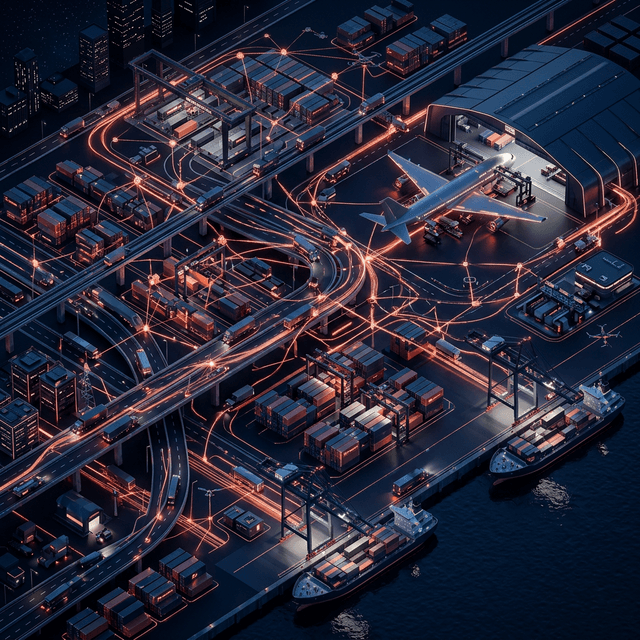

Freight forwarding moves $2.9 trillion of global trade annually—and until very recently, it ran almost entirely on human coordination, PDF attachments, and institutional memory.
But the industry has reached a tipping point. In 2026, AI is no longer a "future technology" for logistics; it is the core operating system. This guide provides a comprehensive roadmap for forwarders and NVOCCs looking to transition from manual operations to AI-native growth.
Logistics is uniquely suited for AI displacement for three reasons:
McKinsey estimates that 60–70% of daily freight workflows are immediately automatable with current AI technology. For a 50-person team, that represents thousands of hours of recovered capacity every month.
To automate a freight business, you must look at the shipment lifecycle in five distinct layers:
The average operations rep spends 6 hours a day in their inbox. Email AI doesn't just "filter" messages; it understands intent. It parses an RFQ, extracts shipment details, and drafts a response autonomously. Voice AI agents handle carrier check-calls and status updates, logging every detail back to the CRM without human intervention.
Speed is the only moat in the spot market. AI-powered quoting connects your rate feeds, carrier contracts, and historical win-rates to generate an optimized quote in under 60 seconds. Navix customers report an 8–10% improvement in win-rates simply by being the first to respond.
Legacy OCR struggled with blurry scans and non-standard layouts. Modern Agentic AI "reads" documents like a human, validating data across House BLs, Commercial Invoices, and Packing Lists. It flags discrepancies—like a weight mismatch between docs—before they become customs delays.
Most forwarders are reactive. AI-native forwarders use trade data (customs filings, AIS tracking) to be proactive. Navix ingests live trade data to alert sales teams when a target account changes carriers or opens a new trade lane.
The final layer is the "Dark Factory" vision. This is where the TMS is no longer a data entry tool, but an autonomous engine. It receives a lead, quotes it, books it, processes the docs, and generates the invoice—all while your team focuses on strategy and high-value relationships.
Many legacy platforms claim "automation," but they rely on rigid rules. If an email doesn't match a specific template, the rule breaks.
AI-Native Automation (Navix) is probabilistic. It understands that "Can I get a price for 2 pallets to LHR?" and "Need a rate for 2skids to London Heathrow" mean the same thing. It adapts to the messiness of real-world logistics.
The transition to AI doesn't require an 18-month implementation. At Navix, we deploy in phases:
The freight forwarding business that runs itself is not a future roadmap; the components are live today. Forwarders who embrace AI-native operations will scale at 1/10th the cost of their manual competitors.
The destination is clear. We are building it.
Ready to see where your business stands? Take the 5-Minute AI Audit →
Most teams start with RFQ handling, email communication, and document extraction because these areas are repetitive, high-volume, and directly linked to response speed.
With integration-ready workflows, initial deployments can start in weeks, beginning with communication and quoting before expanding into document and CRM automation.
Last updated: April 2026 | v1.1